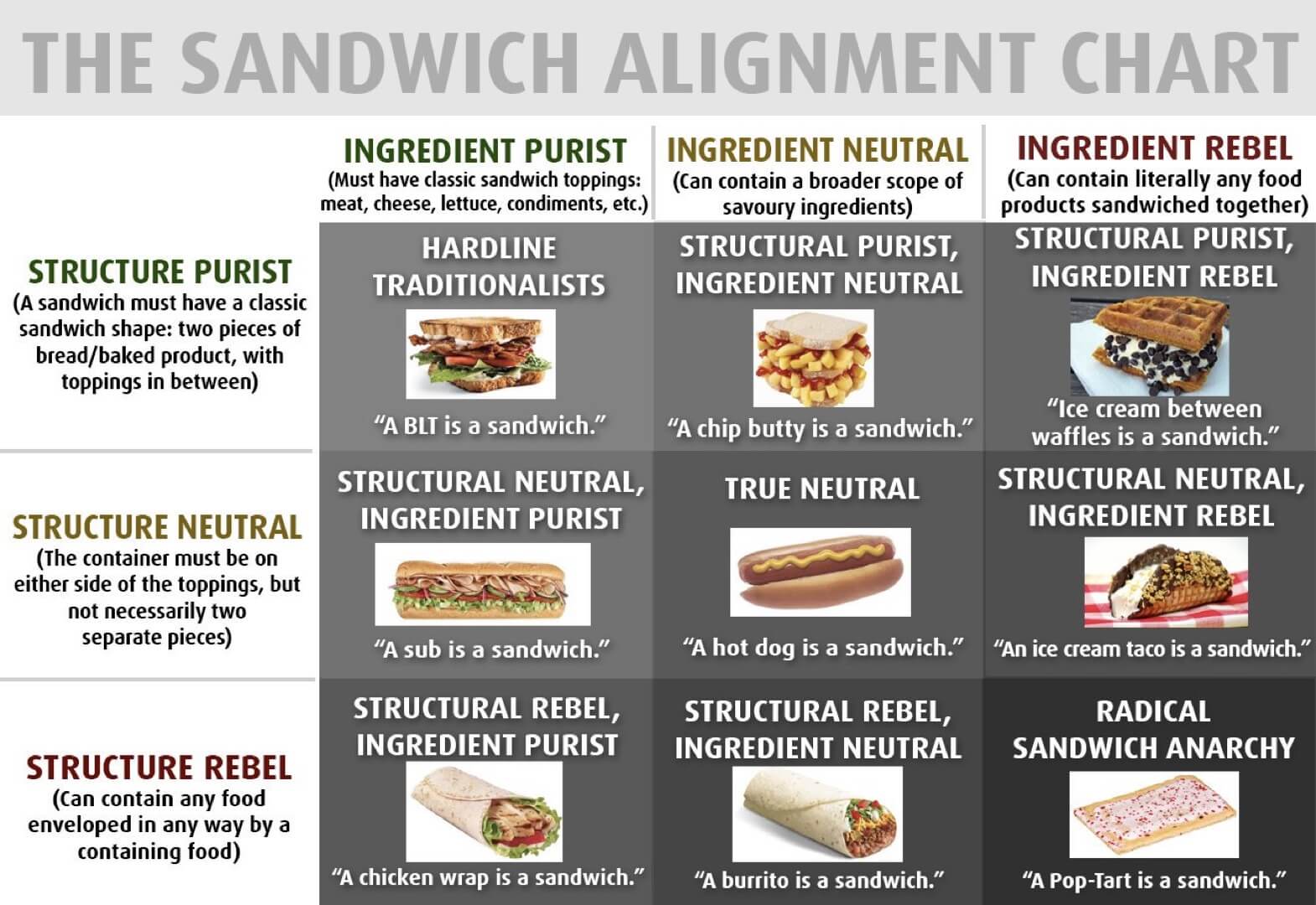
For a number of years now, work has been proceeding in order to bring perfection to the crudely conceived idea of a system of nomenclature that would not only give unambiguous differentiations between different categories of food products for use in solving ongoing debates, both legal and trivial, but would also be capable of distilling the fundamental traits of previously hazily defined food categories. Such an instrument is that presented in this treatise, after due consideration of preceding methods and literature.
The Sandwich Alignment Chart (pictured above) has gained popularity of late as a visual representation of the classification of food items based on their sandwich-like qualities. Created by @matttomic on Twitter, this chart, often presented as a table, categorizes items on two axes: Ingredients, and Structure. The chart takes advantage of the well-known "alignment chart" methodology to display and encourage discourse on various opinions regarding the semantic space of a sandwich. In particular, it takes the position found in the semantic paradigm of Prototype Theory, a categorization theory in the study of Semantics and Cognitive Science. In brief, prototype theory considers semantic categories to be points in a continuum, where items do not belong to unambiguous categories, as in Aristotelian Categorialism, but rather can be measured by how close they are to a prototype, an instance deemed to be representative of the category as a whole, and as such may be considered to reside near or at the aforementioned point. For example, a lizard may still be a pet, but is not the prototypical pet, which would something like a cat or a dog. Furthermore, whether or not a lizard is a pet is not an objectively defined fact, but depends on a person's own experience and internal definition. Some people will be more liberal with what they consider a pet than others. The Alignment Chart attempts to demonstrate this, by inquiring of the reader where they choose to draw the line, and thus both represents a culmination of popular debate on the definition of sandwiches and incites further discussion from the audience it reached.
The diagram as been portrayed as bringing closure to the discussion, but this is simply not the case. Due to the continuous nature of the theory involved, there are no rigorous borders drawn, only a graduated scale from "definitely a sandwich" to "some people would consider a sandwich", entirely dependent on personal preference. This means that the chart is merely a lens to aid discussion of the definition of sandwiches, acknowledging the differing viewpoints that all people hold. This relativist point of view is perhaps the only real solution to such debate, but although it feels like the "moral high ground", and is invaluable an opinion for a person to hold, most would agree that this is not a real solution at all, and as a matter of principle one must indulge in the polemic and settle, for better or for worse.
To conclude, the Sandwich Alignment Chart to outline a framework for describing individual people's definitions on a 2-dimensional semantic space. However, its use of prototypical methods does not provide an empirical answer to the question "What is a sandwich?", for those who prefer classical theories of semantic categories.
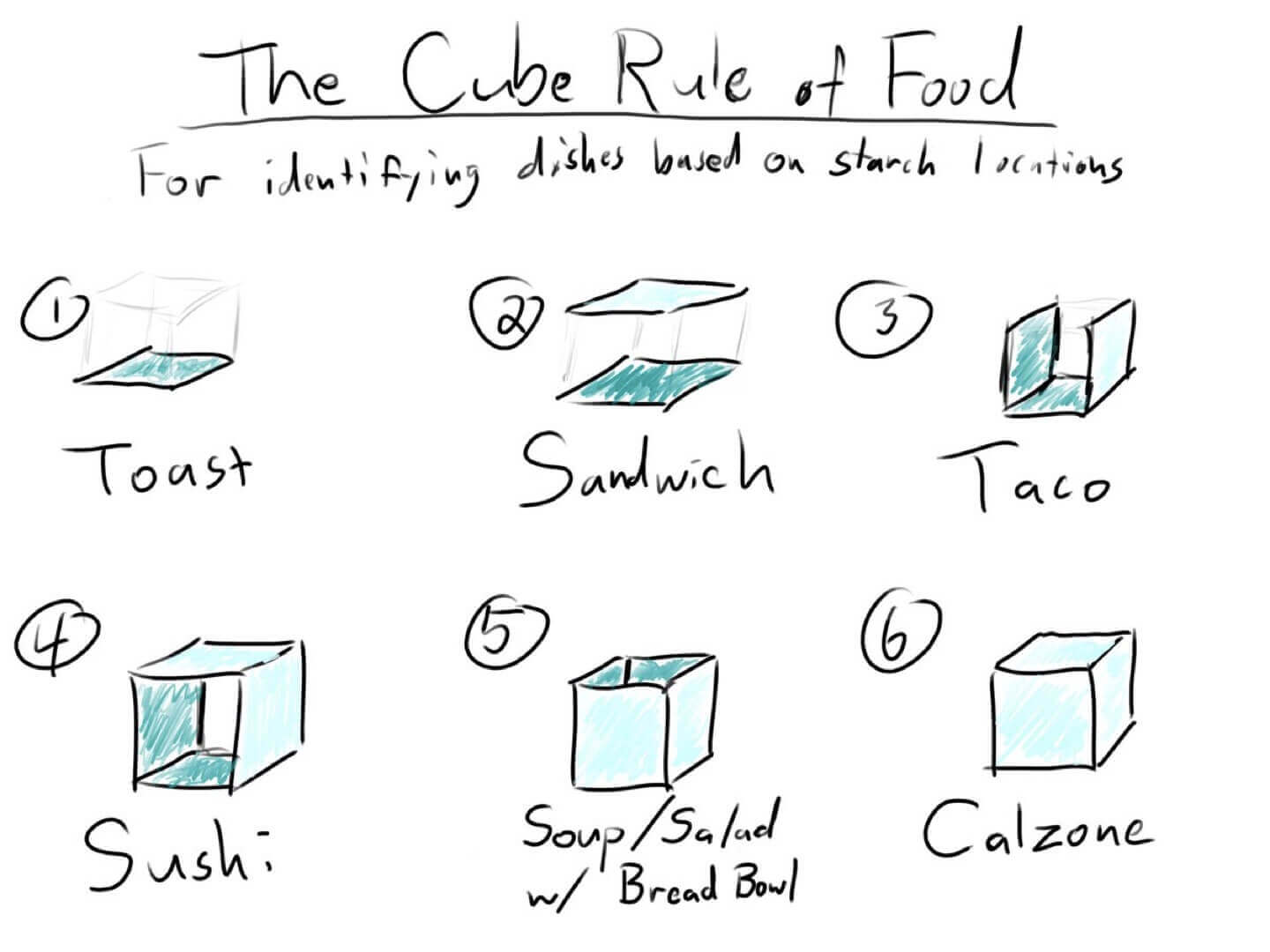
The Cube Rule is a geometric classification system for foods that uses the analogy of a 3-dimensional cube. It claims to be able to "identify any food purely by the location of structural starch", and does so by assigning names to specific configurations of the cube. For example, the Cube Rule solves the initial question of "What is a sandwich" by informally stipulating that a Sandwich is a foodstuff such that the "structural starch" is positioned in layers at the top and the bottom, using a diagram of a cube wireframe with the top and bottom faces highlighted. Thus, a conventional sandwich fits this definition, as does a two-tiered sponge cake, but not a hot dog. Instead, a hot dog is classified as a Taco, a configuration such that the bottom, left, and right sides are "structural starch". According to André Arko's modification of the original Cube Rule (as specified on https://cuberule.com), other food items that are classified as "taco" include a submarine sandwich, and a slice of pie (specifying that the latter is a "taco on its side"). This suggests that the configurations are independent of orientation, and thus according to this system rotating a food item does not change its category, and likewise the given orientations of the cube diagrams are not prescriptive of the orientation of a food in order to meet its criteria.
Also of note is the complete dissipation of the ingredient consideration present in preceding discourse. The Cube Rule disregards the composition of the food item apart from the "structural starch" it contains (to which more consideration is given below), meaning it occupies the Structural Purist, Ingredient Rebel position on the Sandwich Alignment Chart. This is a most natural continuation, given that the positioning of the bread was found to be the most critical aspect under inspection, and the filling largely irrelevant.
The categories given are as follows:
Before going further into the details, some points must be mentioned regarding the "Additional Cube Rulings", Cake and Nachos. The diagram given for Cake shows a cube with an additional layer going horizontally through the middle, which is highlighted along with the top and bottom. The exemplary food items given are a Lasagna, a Big Mac, and Flapjacks (also called Pancakes, Griddlecakes, or Hotcakes), where the image for the latter is as follows:
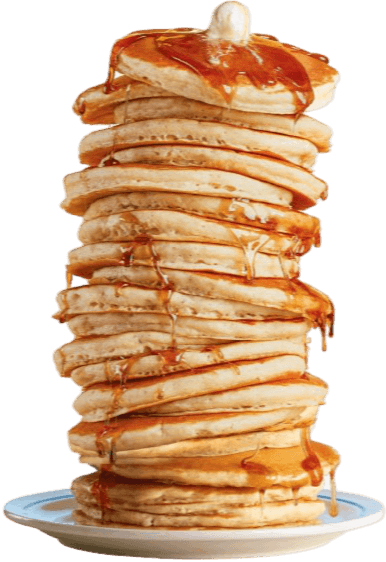
This implies that the Cake category refers to any configuration of any number of parallel sides, like an upward extension of the Sandwich. It may be presumed that a single Pancake would in the Toast class, and that a pair of pancakes stacked upon one another would be a Sandwich.
The Nachos category is the hardest to define. The cube diagram shows none of the wireframe sides highlighted, but with a small, fully highlighted cube inside. The examples given are Poutine, Lucky Charms™, Salad with Croutons, Fried Noodles, Couscous, and Ramen. From this it may be gleaned that this category refers to small, solid starches, usually numerous (though the size is not specified), and the presence of noodles and ramen means these items can be stringy in shape.
Although the cube diagram is intuitive, its execution naturally raises some questions. Firstly, a rigorous definitions must be established for "structural starch". Analysis and consideration of the examples given lead to the conclusion that the cube is not merely a framework for expressing the shape of a body of starch, but a depiction of the positioning of the starch relative to the rest of the food item. The category name for a single side is Toast, with connotation of having something placed on top of the "structural starch". Furthermore, one of the examples of the Sandwich category is a Toast Sandwich, a foodstuff that is almost entirely starch. However, in this situation, the inner slice is different from the outer slices, because of the intention, and the role they play in the composition of the food item. Although this is an unusual edge case, it is true that there exists a large number of foodstuffs that are made from a starchy component, and a more flavorsome component. The starch exists to complement the rest, to give it structure, texture, and make it easier to consume (consider the history of the Cornish Pasty). Therefore, we may define "structural starch" (henceforth referred to as S.S.) as the starchy component of a meal that is subordinate to the main focus of the item, and which often surrounds or supports the rest in some way, such as the shell of a Taco or the bread in a Sandwich.
If one identifies the centre of the food item (not exclusively the geometric centre, context must be taken into account), and considers the coverage of any layers of the S.S. around that centre, one can evaluate that coverage by considering the sides of a cube.
A cube is a familiar shape, and as demonstrated by the diagrams, easy to visualise. Compare, for example, how difficult it would be to use the analogy of a tetrahedron, despite it being a simpler polyhedron. It has enough sides to provide an appropriate resolution, and has the significant advantage of possessing parallel sides, which naturally lends itself to many types of food like sandwiches.
Despite the success and ease-of-use of the system, it is not without flaws.
Firstly, it fails to provide obvious and hard boundaries between some of the categories, it is only an informal rule of thumb, and leaves a lot up to interpretation, of which the above is only one. Given that the ostensible goal of such a system is to provide a single source of truth on food categories, this is problematic. The system subscribes to the classical Categorialist perspective, in which all objects either belong to, or do not belong to, a given category, and cannot belong to multiple. But in order to do so, it must define rules that govern these categories, and the way in which the cube analogy is implemented might not suffice.
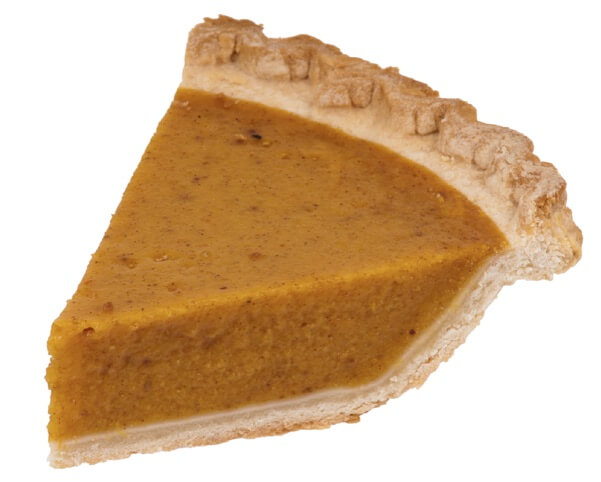
For example, notice how a "pumpkin pie slice" (pictured below) is classified as Toast, with a note specifying that it is "bent toast". However, would it not be more logical to depict it with two contiguous sides, the bottom and the wall? However, if we were to rotate such a configuration (which we have previously established does not affect the classification of an item), would it not be flat enough to count as Toast? What if a Pizza was slightly bent, would it suddenly become a new class of food? Certainly if it were folded over completely, but where does one draw the line?
Consider unfolding a taco. When it is flattened out, it is obviously Toast, but before it was Taco. At some point during the transformation, it ceased to be a Taco and became a Toast. But when?
The lack of a concrete boundary point would lead naturally to the conclusion that there is no fundamental difference between the two. Nevertheless, it would seem that there is still some distinction between Toast and Sandwich. This reasoning resembles that of the mathematical field of topology.
In topology, bodies are considered indistinguishable if they can be molded into one another in a continuous manner (a continuous deformation, termed homeomorphism). For example a loaf of bread and a Taco shell are homeomorphic, but a loaf of bread is not homeomorphic to a Bagel, or to the two slices of bread in a sandwich. This is because a bagel has an irremovable (in terms of homeomorphisms) hole in it, and a sandwich has two disconnected structural starch bodies.
The conventional first definition of the Euler Characteristic, χ, of a surface is the surface's vertices and faces, minus its edges.
χ = V − E + F
However, two other equations will be more valuable for this endevour, firstly, one which gives χ in terms of its genus (informally, the number of “holes”--where a hole is a full pierced through-way, not a simple divot), g, and its boundaries, b. A disc necessarily has a boundary, but a sphere's surface is boundless.
χ = 2 − 2g − B
When you have multiple disconnected bodies, the Euler characteristics add. This is called the disjoint union. However, this does unintuitive things to the genus of such a disjoint collection of manifolds.
The Euler Characteristic is a topological invariant, meaning it does not change under a homemorophism. This means two homeomorphic objects must have the same Euler Characteristic. However, it does not mean that two objects with the same Euler Characteristic must be homeomorphic, especially considering the disjoint union, which results in various unnacceptable ambiguities if we rely upon it or the genus for our categories, like two toroidal objects being classified identically to one. Furthermore, the mathematical nature of the disjoint union is unsuitable for indeterminate quantities of bodies. Nevertheless, a semblance of a useful system lies herein.
In 3 dimensions,
χ = b0 − b1 + b2
Where bn is the nth Betti number, which is sometimes described as the number of n-dimensional holes which the manifold has. It turns out that these three values describe very useful properties when approximated informally:
Note how, due to the inversion of polarity in the equation, 2-dimensional holes almost cancel out 1-dimensional holes.
The interplay of these three numbers produces interesting effects when taken across different types of manifolds in different quantities and orders. The table below captures an enourmous amount of detail in a simple matrix of values, and even the proceding commentary will not fully substitute for careful study.
| Manifold | B | b0 | b1 | b2 | χ | g | b2-b1 | H | m |
|---|---|---|---|---|---|---|---|---|---|
| Interval/Line | 1 | 1 | 0 | 0 | 1 | 0 | 0 | 0 | 0 |
| Circle | 0 | 1 | 1 | 0 | 0 | 1 | -1 | 1 | -1 |
| Sphere | 0 | 1 | 0 | 1 | 2 | 0 | 1 | -1 | -1 |
| Two Spheres | 0 | 2 | 0 | 2 | 4 | -1 | 2 | -2 | -1 |
| n Spheres | 0 | n | 0 | n | 2n | 1-n | n | -n | -1 |
| Disc/Ball | 1 | 1 | 0 | 0 | 1 | 0 | 0 | 0 | 0 |
| Two Balls | 2 | 2 | 0 | 0 | 2 | -1 | 0 | 0 | 0 |
| n Balls | n | n | 0 | 0 | n | 1-n | 0 | 0 | 0 |
| Torus | 0 | 1 | 2 | 1 | 0 | 1 | -1 | 1 | 1 |
| Two Tori | 0 | 2 | 4 | 2 | 0 | 1 | -2 | 2 | 1 |
| N Tori | 0 | 3 | 2n | 3 | 0 | 1 | 3-2n | 3 | 1 |
| Double Torus | 0 | 1 | 4 | 1 | -2 | 2 | -3 | 2 | 2 |
| 2 Double Tori | 0 | 2 | 8 | 2 | -4 | 3 | -6 | 4 | 2 |
| n Double Tori | 0 | n | 4n | 3 | -2n | 1+n | 3-4n | 2n | 2 |
| Triple Torus | 0 | 1 | 6 | 1 | -4 | 3 | -5 | 3 | 3 |
| m-ple Torus | 0 | 1 | 2m | 1 | 2-2m | m | 1-2m | m | m |
| n m-ple Tori | 0 | n | 2nm | n | 2n(1-m) | 1-n+m | n-2nm | nm | m |
Consider a sphere. It is hollow (b2), but has no “holes” (b1)in the conventional sense. Its genus is 0, and its Euler characteristic is 2, the sum of the 1 b0 and 1 b2, the substance and the cavity. If we take the disjoint union of it and another sphere, their Euler characteristics add, to a total of 4. Each sphere has a b0 of 1 and a b2 of 1, giving us 4. For every sphere we add (in a disjoint union), χ increases by 2, but g decreases by 1.
Consider a solid ball, or disk. There are no cavities and no holes, therefore its Euler characteristic is 1 + 0 + 0 = 1. It is a bounded shape, with a B=1. As we accumulate balls, chi goes up by 1, and g goes down by 1.
Consider a torus. It is a hollow shape, with two holes (that through the middle and that around the inside). The cavity "cancels out" one of these holes giving it a genus of 1, euler characteristic 0. Since chi is 0, it does not increase when we consider more tori together, the betti numbers increase such that chi and g stay the same.
We end up with rows in the table. Following either the genus or the Euler characteristic down the table, it is clear that neither of these numbers is fit as a measure of our naïve idea of holes or punctures in these circumstances, which would be something like H. H, our “naïve” holes, captures b1 and b2 in a single number by being negative in the case of the hollow sphere. Undesirable results, however, would ensue if an object contained both cavities and through-holes, since they would cancel each other out entirely and remain stealthed.
By dividing H by b0, we get a kind of identity value, constant across any quantity of the body, that identifies the particularites of the common manifolds we dealt with. It is -1 for a hollow sphere, 0 for a a solid ball, 1 for a single-holed torus, and generalizes up to m for an m-holed torus.
Out from the chaos of the previous section’s topologically-grounded metrics, none of which seem to agree with each other in the way one wants, emerges in a zen-like manner the purity of a system in the tradition of the Cube Rule which is founded upon the topological philosophy of the homeomorphism, which does not give the mathematics the respect it deserves, but performs well enough the impossible balancing act between the formal and the functional.
What follows, then, is a proposal for a mathematically grounded set of categories, that takes the underlying concepts of the Cube Rule, and extrapolates them to their logical extreme, whilst also clearing up much of the uncertainty involved. A fixed set of English words are assigned to these mathematical classes to concretize our intuitions about these names.
The Cube Rule's concept of Structural Starch is useful. Specifying starch eliminates any unwanted consequences of simply using "carbohydrate" (which would arguably include sugars, leading to concerning definitions like Chocolate being a Nachos). The above semantic definition of structural starch requires little improvement to fit this system. It does justice to the role of staple carbs in the structural composition of foods across human cultures, and while there is room for a bit of debate of which parts of a food are considered “structural” rather than contents, this is a reduced and acceptable weak point in a system otherwise much more rigorous than any previous attempt.
The primary change on top of the Cube Rule is that the bodies under inspection here may be in any orientation. The 9 categories have thereby been simplified into a hierarchical, two axis, nature. This more flexible, and convenient to expand: unnamed combinations are still convered and may be assigned names if necessary. Furthermore, by giving a default value to each axis many common combinations can be represented by a single word, in a way that proves to be surprisingly intuitive. The two axes are Quantity, which corresponds to the 0th Betti number of the disjoint union of identical trophic manifolds, and Genus, which has its theoretical roots in the topological genus g, the 2nd and 3rd Betti numbers, and our intuitive identity metric m.
| n | Name |
|---|---|
| 0 | Salad Contains no structural starch |
| 1 | Loaf Contains one body of S.S. |
| 2 | Sandwich Contains two bodies of S.S |
| 2 | Cake Contains more than two body of S.S |
| >2 | Nachos Contains many bodies of S.S.* |
The Loaf classification is assumed in default and may be omitted if desired.
*The distinction between Cake and Nachos is a subtle but intuitive one, included for the purpose of gaining greater resolution for dealing with multiplex foodstuffs. It may be argued that it introduces further ambiguity, but in practice a boundary rarely encountered. Should a distinction be necessary, many may be defined as >5, but do not hesitate to label some kind of extraordinary 6-tiered wedding cake as Cake, for instance. Although it has been stated that this system is conceptually based in mathematics, it is really based in the human conception of mathematics, which subtly differs from mathematics as it exists outside of the minds of those who study it due to the limitations of the human mind's ability to manipulate concepts. Paucal categories exist, grammatically or not, in basically all human languages. This is a system designed to be unambiguous, yes, but it is also designed to be used by humans, who are anything but.
This is the identiy of the single manifold that each of the others is a assumed to be a duplicate of, not of the disjoint union of all of them. The presence of irregular/anomalous bodies is not considered, e.g. a malformed pretzel with only one hole does not affect the classification of the whole bowl of pretzels. Note that this forbids joint consideration of bodies of different form, e.g. no single classification can be given to a plate of Fish and Chips, because the components have different m values.
Additionally, the third place where informal human judgement is forced to be introduced is the disregarding of small holes in leavened bread or similar foods. One could, if so desired, remove this uncomfortable caveat and revel in the painful joy inhuman rigor, but then the issue of molecular-scale holes arises, and one realizes that all objects are filled with tiny holes and therefore, everything is pretzels.
Or, if this is unsatisfactory, rule out small holes. Bagel holes and calzone cavities count, bread bubbles don’t.
| m | Name |
|---|---|
| -1 | Calzone |
| 0 | Toast |
| 1 | Bagel |
| >1 | Pretzel |
When writing the classification of a Toast classification is assumed and may be omitted if desired.
The final of many fascinating philosophical ideas uncovered by this system is the inevitable realization that the names we give these categories, after all this struggle to define them, are actually the least important part. Even in translating this system to another language one would find that the words no longer match up. The appropriated words lose their original meaning, become technical terms, just like how when a topologist talks about genus, they mean a completely different thing than when a zoologist does. We have not decided whether a hotdog is a sandwich or not, merely invented a category and named it with the same sound as the unrelated word "sandwich", and placed hotdogs outside of that category. Nominalism becomes inevitable, a Cake by any other name would smell as sweet. Whether, for our hollow b2=1 category, we choose the word "Calzone", "Ravioli", "Pop-Tart", "Wug", "Glorp", "Foobar", or even something deliberately confusing like "Bagel", it does not affect the substance of our system.
The real insight, once we escape from the hole of confusing mathematics we dug, is that only the homeomorphic form of the S.S. is worth considering, because if one does, the quantity of needed categories diminishes. Where or what way around it is is irrelevant, only the holes or cavities.
It should be noted, however, that the above proposal is only one, not flawless or completely unopinionated, implementation of the theory discussed herein, and the author does not dismiss the possibility of an improved system. There is a great deal of subtle complexity at the interface of the Betti-number-based metrics and the words we choose to describe their combinations. The author welcomes critique and iteration, be it from directions mathematical, linguistic, or pedantic.